
Story map
- 01Margin trading on the CSE starts with a simple promise
- 02The current rate question is harder than it looks
- 03A margin call is not a polite reminder
- 04Forced selling turns liquidity into the real risk
- 05The 50% ceiling can still be too aggressive
- 06Risk management has to begin before the purchase
- 07The broker relationship can blur the risk
- 08Who should be most careful now
- 09The practical takeaway is capital survival
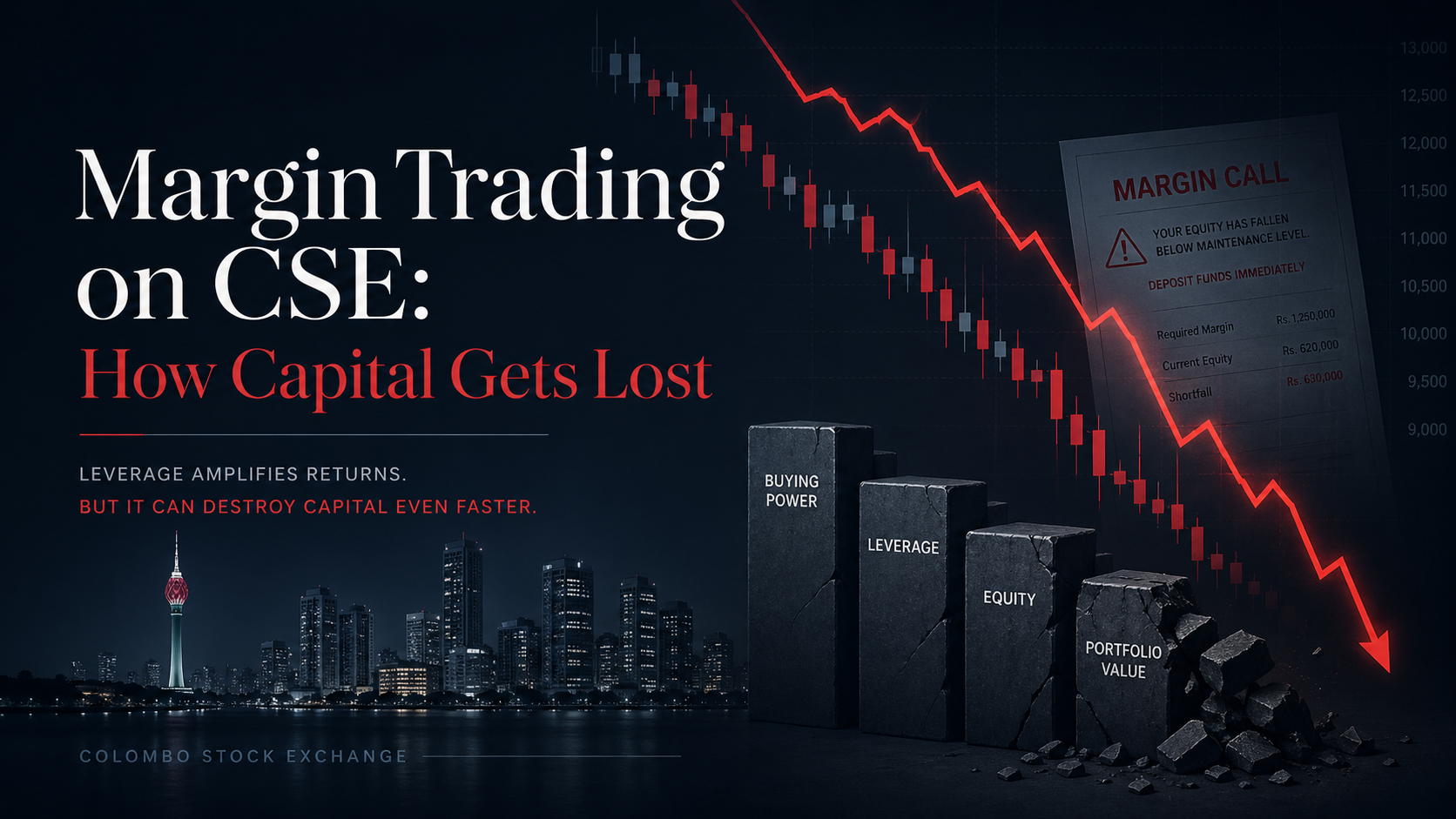
Margin trading on the Colombo Stock Exchange can destroy capital fastest when a falling share price, interest cost, and forced selling meet in the same thin order book. The formal leverage ceiling is not mysterious: Sri Lanka’s SEC margin-trading material states that initial margin on share purchases should not exceed 50% of the cash value of eligible marginable securities, while the maintenance margin is 30% unless the Commission changes it. That means a buyer who feels twice as powerful on day one can become powerless within a few bad sessions. ([SEC Sri Lanka][1])
The danger is not only that borrowed money magnifies losses. The sharper danger is that the decision to sell may move from the investor to the margin provider at exactly the wrong time. In a liquid market, forced selling is painful. In a highly illiquid market, it can become a price event by itself.
Start here
The short version
- 01A story-led look at how margin trading on the Colombo Stock Exchange works, why current rates must be confirmed directly with providers, and how margin calls can become dangerous in illiquid shares.
- 02The sales pitch is easy to understand. An investor has a share portfolio in the Central Depository System, pledges eligible securities to a lender or margin provider, and receives a credit facility to buy more shares or settle purchases.
- 03Investors often ask one practical question first: what is the current broker margin rate?
Method, source and disclosure
This analysis is prepared by the Market Lens desk from the sources named in the story and publicly available market information. Material revisions appear in the updated timestamp.
Margin trading on the CSE starts with a simple promise
The sales pitch is easy to understand. An investor has a share portfolio in the Central Depository System, pledges eligible securities to a lender or margin provider, and receives a credit facility to buy more shares or settle purchases. Capital TRUST’s public explanation describes margin trading as a facility where a quoted share portfolio is pledged and credit is obtained up to 50% of the market value of the pledged portfolio, with the facility arranged through a tripartite structure involving the lender, investor, and stockbroking firm. ([web.capitaltrust.lk][2])
That structure matters because margin trading is not just a private bet between a trader and a broker. It sits inside a regulated chain. The investor owns the risk. The broker executes trades. The margin provider monitors collateral. The CSE provides the market infrastructure. The SEC sets rules around the facility.
For a rising portfolio, the arrangement feels smooth. The investor sees additional buying power. The account statement shows a loan balance, interest, and collateral value. A rally makes the loan look manageable because the asset side of the account is expanding. That is the emotional trap. The investor starts to treat borrowed exposure as normal exposure.
Then the market turns. A share that looked easy to sell at yesterday’s close opens with a weak bid. A small block goes through lower. Another seller appears. The account’s collateral value falls, but the loan balance does not fall with it. Interest keeps accruing. The same structure that looked flexible on the way up becomes rigid on the way down.
That is why the fastest losses in margin trading often do not come from one dramatic collapse. They come from a sequence: a modest fall, a margin warning, thinner bids, a forced sale, and a lower reference price that hurts the rest of the pledged portfolio.
The current rate question is harder than it looks
Investors often ask one practical question first: what is the current broker margin rate? The honest answer is that Sri Lanka does not have one single public margin rate that applies across every CSE investor. Public pages from providers and broker-linked finance partners commonly describe rates as “competitive” or “attractive,” while the actual rate can depend on the provider, loan size, collateral quality, client relationship, and whether the rate is fixed or floating. Dialog Finance, Sampath Bank, Assetline Finance, CDB, Capital TRUST-linked material, and LOLC-linked material all present margin facilities publicly, but most public pages direct investors to contact the provider rather than giving a single universal percentage. ([dialogfinance.lk][3])
That does not make the rate unimportant. It makes the rate negotiation more important. A margin borrower should not only ask for the headline annual interest rate. The real cost is the all-in financing burden: interest calculation method, compounding or debiting frequency, penal interest after a breach, documentation charges, settlement timing, and whether the rate can move when market interest rates change.
The macro backdrop also matters. Reuters reported that the Central Bank of Sri Lanka held its benchmark policy interest rate at 7.75% on March 25, 2026, after a period in which domestic rates had eased from crisis-era levels. That policy rate is not the margin-loan rate, but it shapes funding conditions for lenders and the return hurdle for investors using leverage. ([Reuters][4])
A simple example shows the pressure. If an investor borrows to increase exposure, the purchased shares must first overcome brokerage, taxes, levies, spread, and financing cost before the investor has made a genuine economic gain. The CSE’s transaction-cost material shows that equity trading carries layered transaction costs, with costs varying by transaction size and brokerage terms. ([CSE][5])
This is where many retail investors misread the trade. They compare a potential share-price move with the interest rate alone. They forget the entry cost, the exit cost, the bid-offer spread, and the possibility that exit liquidity disappears when they need it most.
A margin call is not a polite reminder
A margin call sounds administrative. In reality, it is the point where the market’s fall has become a contractual problem. The pledged securities have lost enough value that the account no longer meets the required maintenance margin. The investor must restore the account by adding cash, adding acceptable securities, or selling securities to reduce the shortfall.
SEC rules for margin providers state that where the securities in the account fall below the maintenance requirement, the client must respond to the margin call within three market days by providing cash or marginable securities, or by instructing the margin provider to sell securities to recover the shortfall. If the investor fails to respond within three market days, the margin provider is allowed to recover the maintenance shortfall. ([SEC Sri Lanka][6])
That three-market-day window is crucial. It is long enough for an investor to make a decision, but not long enough to rescue a weak portfolio if cash is not ready. It is also not a guarantee that prices will remain stable while the investor thinks. A security that falls on Monday can keep falling on Tuesday and Wednesday. The required repair can become larger before the response deadline arrives.
The pressure is harsher when the pledged portfolio is concentrated. A diversified margin account may have several lines that can be trimmed. A concentrated account has fewer choices. If the main holding is also the falling security, selling it may push the account into a worse position by crystallising losses and reducing future recovery potential.
In practice, a margin call changes the investor’s time horizon. A long-term thesis becomes a three-day funding question. A valuation argument becomes a cash-flow problem. A market opinion becomes a deadline.
Leverage does not ask whether the original thesis was intelligent. It asks whether the collateral is sufficient today.
Forced selling turns liquidity into the real risk
Forced selling is the mechanism that makes margin trading especially dangerous on the CSE. In deep markets, a forced sale can be absorbed across many buyers and market makers. In thinly traded shares, one sell order can walk down the order book. The investor loses not only because the share price is lower, but because the act of selling may help make it lower.
The Colombo market has liquid names, but it also has many counters where daily turnover can be uneven. A share may look comfortably tradable when sentiment is strong because buyers are visible. That same share can become difficult to exit when the broader market weakens or when company-specific disappointment appears. The screen still shows a last traded price, but the available bid size may be too small to support a meaningful sale.
This distinction is vital. Market value is not the same as realisable value. A portfolio worth LKR 10 million at last traded prices may not be worth LKR 10 million if it must be liquidated quickly. The more urgent the sale, the wider the gap between accounting value and cash value.
Forced selling also has a signalling effect. When a stock starts falling on volume, other investors may suspect margin pressure even if no one confirms it. Buyers step back. Sellers move faster. The spread widens. The margin investor who expected to sell one line at a fair price may face a market where every bid feels temporary.
This is why illiquidity is not a side note in Sri Lankan margin trading. It is central to the risk. A leveraged investor in a thin counter is not only betting that the price will rise. The investor is betting that someone else will provide liquidity when the trade goes wrong.
The 50% ceiling can still be too aggressive
The regulatory ceiling is not a personal risk target. A facility that allows borrowing up to 50% of the value of eligible securities does not mean every investor should operate near that limit. The difference between permitted leverage and sensible leverage is where many losses begin.
At 50% financing, a relatively small fall in collateral value can create a large change in account safety. A 10% fall in the market value of shares is not a 10% issue for a leveraged investor. It reduces equity faster because the debt remains. A 20% fall can move the account from confidence to stress. A 30% fall can turn the portfolio into a forced decision.
The problem becomes more severe when the borrowed funds are used to buy more of the same theme. An investor may pledge bank shares to buy more bank shares, or pledge a cyclical portfolio to buy another cyclical name. On paper, there are several securities. In risk terms, there may be only one trade.
A strong market encourages that behaviour. When many shares rise together, correlation feels like skill. Margin makes the gains visible. Friends talk about returns. The account balance grows. The investor increases the facility because the collateral value has increased. Then a macro shock, disappointing result, policy change, or foreign selling wave hits the market, and the same correlation works in reverse.
Leverage is most seductive immediately after it has worked. That is also when it is most likely to be increased.
Risk management has to begin before the purchase
Good margin discipline is boring before it is valuable. It starts before the first borrowed rupee is used. The investor must know the maintenance requirement, the lender’s call process, the interest method, the eligible securities list, the haircut or valuation policy, and the provider’s right to sell.
The most practical rule is to keep a cash buffer outside the margin account. A buffer held inside the same falling portfolio is not a buffer. If the market falls, the investor needs cash that is not also losing value. Without that cash, the investor’s only rescue tool is selling securities into weakness.
A second rule is to size positions by liquidity, not only conviction. A highly liquid blue-chip position and a thinly traded small-cap position may show the same rupee value in a portfolio statement, but they are not the same under stress. The thinner the counter, the lower the leverage should be.
A third rule is to treat interest as a hurdle rate. If the all-in annual financing cost is high, the share must generate enough return within the holding period to justify the risk. That return is not guaranteed by a story, a broker note, or a sector theme. It must appear through price appreciation, dividends, or both.
One compact checklist is enough for most investors before they use margin:
- Know the exact annual rate, calculation basis, and penalty terms.
- Keep a cash reserve that can meet a margin call without selling shares.
- Avoid using maximum available leverage on illiquid counters.
- Run a fall scenario of 10%, 20%, and 30% before buying.
- Decide the exit level before the lender decides it for you.
The checklist is simple because the failure pattern is simple. Investors lose control when they borrow too much, concentrate too much, and assume liquidity will be available.
The broker relationship can blur the risk
Margin trading often arrives through a trusted relationship. The investor knows the broker or adviser. The provider may be a recognised finance company or bank. Statements arrive through a professional system. The language is formal and regulated. That can make the facility feel safer than it is.
Regulation reduces misconduct risk, but it does not remove market risk. A properly documented margin facility can still create a large loss. A licensed provider can still force a sale if the account breaches requirements. A broker who likes the client can still be unable to stop the mathematics of collateral deterioration.
This is where financial literacy matters. The investor should read the agreement not as a formality, but as a stress document. The important clauses are not only the ones about how to open the facility. The important clauses explain what happens after a breach, how quickly the provider can act, which securities count as acceptable collateral, and whether the provider has discretion to reject certain securities or value them conservatively.
There is also a behavioural issue. When an investor uses own cash, a falling share is painful but manageable. The investor can wait, reassess, or accept a loss. When an investor uses borrowed money, the lender’s timeline enters the trade. The account is no longer governed only by belief. It is governed by ratios.
That is the quiet change margin introduces. It converts market volatility into a compliance event.
Who should be most careful now
The investors most exposed are not always the most speculative. A cautious investor can become highly exposed by borrowing against a portfolio that appears stable. If the portfolio is concentrated in a few names, the account may behave more aggressively than the investor expects.
Newer investors should be especially careful because the first successful margin trade can teach the wrong lesson. A leveraged gain feels like validation. It can hide the fact that the investor took a larger risk than intended. The next trade may be larger. The third may use more of the available facility. By the time the market turns, the habit is already built.
High-net-worth investors can also misjudge the risk if they view margin as a convenience facility rather than market leverage. The ability to pledge a large portfolio does not make the facility harmless. Large accounts can face large forced sales, and large forced sales in thin counters can damage price realisation.
Operators and directors holding listed-company shares should be cautious for another reason. Margin pressure can interact with reputation, disclosure sensitivity, and market perception. A forced sale in a connected name can be read by the market as a signal even when the underlying reason is financing stress.
The common thread is control. Margin is acceptable only when the investor can remain in control under adverse prices. If a 15% fall would require urgent borrowing from elsewhere, the facility is already too large.
The practical takeaway is capital survival
Margin trading is not automatically reckless. Used conservatively, it can provide temporary liquidity and additional flexibility for experienced investors who understand collateral, interest, and exit risk. The danger begins when the facility is treated as free buying power.
For CSE investors, the margin decision should start with the downside rather than the upside. Ask how quickly the position can be sold, how much the price may move during that sale, how much cash is available outside the portfolio, and what the lender can do after a margin call. Ask for the current rate in writing, including all charges and reset terms, because public marketing language is not enough.
The market will always offer stories that make leverage tempting. A recovery narrative, a banking-sector rerating, a tourism rebound, a construction cycle, a dividend theme, or a low-rate environment can all sound convincing. Some of those stories may even be right. Margin can still punish the investor if the timing is wrong and liquidity disappears before the thesis plays out.
The safest way to think about margin trading on the Colombo Stock Exchange is not as a tool for getting rich faster. It is a tool that must be small enough to survive being wrong. Once the lender, the clock, and a thin order book are in charge, capital preservation is no longer a slogan. It is the only thing left to manage.